Linux x86_64 & ARM64 · Windows WSL2 · macOS (beta)

The zero-trust governance layer
for AI agents.

Docker isolates environments. Envpod governs access to real ones.

AI agents are only useful when they can work with your real files, tools, and workflows. But direct host access breaks the trust model. Envpod lets agents work in your real environment through a copy-on-write layer, so every change is reviewable before it reaches the host.

curl -fsSL https://envpod.dev/install.sh | sh
Linux · x86_64 or ARM64 · Windows WSL2 · macOS beta · ~9 MB
$ envpod diff my-agent
M  .gitconfig
A  src/utils.py
A  src/helper.py
D  tests/old_test.py
A  node_modules/...  (47 files)

$ envpod commit my-agent src/ --rollback-rest
Committed 2 file(s). Rolled back 48.

Nothing lands on the host until you review it.

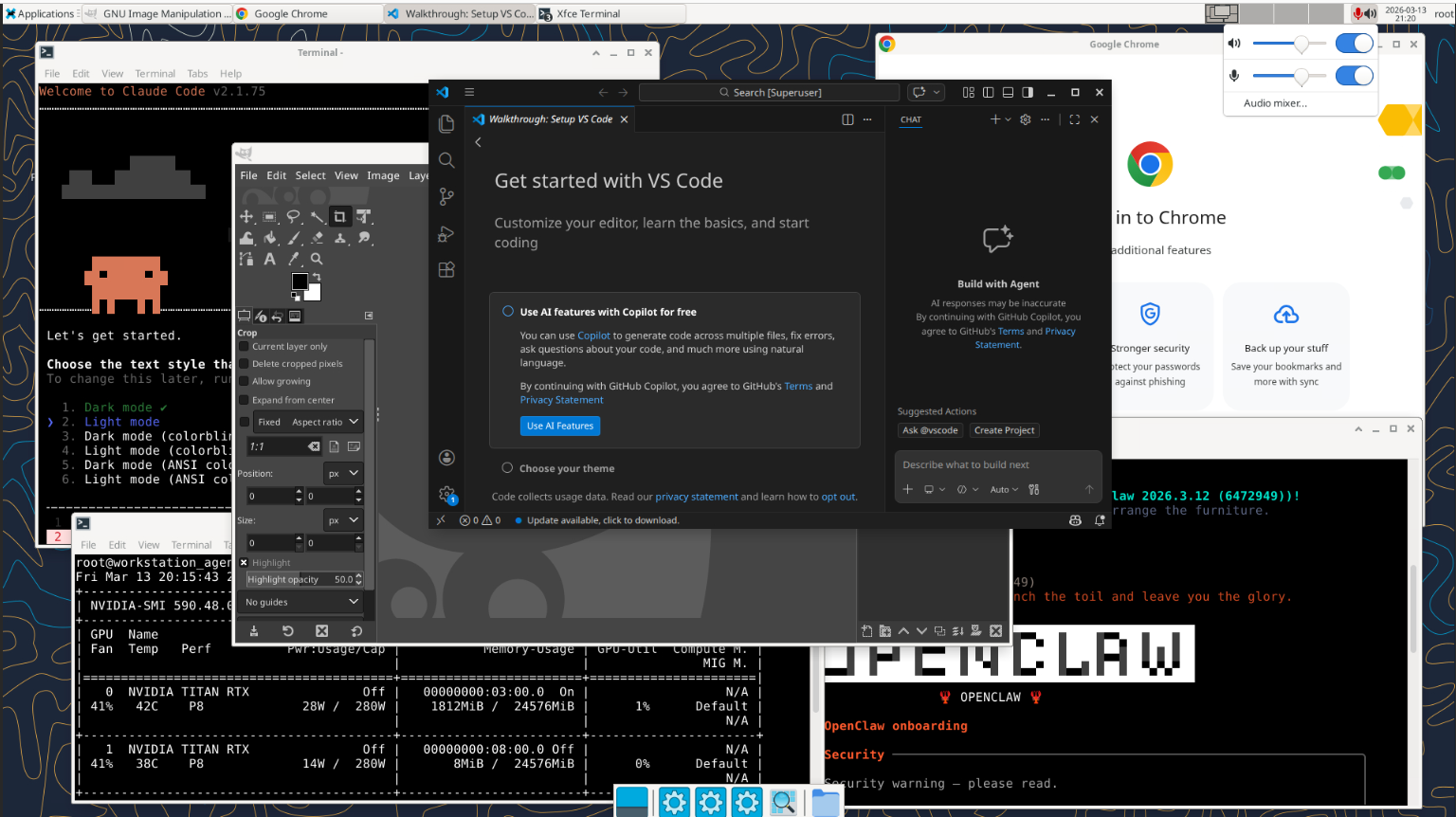
$ envpod init full-ws -c workstation-full.yaml
Pod Created · full-ws  1.1s
  Display  noVNC → http://10.200.3.2:6080/vnc.html

$ envpod start full-ws
 Chrome, Firefox, VS Code, GIMP, LibreOffice
 XFCE desktop via noVNC in your browser
 GPU passthrough, audio streaming
 2.6 GB overlay (host not duplicated)

Full desktop for AI agents. 83 lines of YAML.

envpod full desktop — Chrome, VS Code, terminal in XFCE via noVNC

Full desktop in your browser. Chrome, VS Code, GIMP, LibreOffice — governed.

$ envpod vault my-agent set ANTHROPIC_API_KEY
 Encrypted with ChaCha20-Poly1305

$ envpod run my-agent -- env | grep API
# nothing — agent never sees the key

# vault proxy injects credentials into HTTPS
# requests transparently. Zero-knowledge.

Agent never sees your API keys.

$ envpod audit my-agent
14:23:01  Create    pod initialized
14:23:05  DnsQuery  api.anthropic.com 
14:23:06  DnsQuery  evil.corp ✗ blocked
14:23:12  Commit    src/utils.py +47 lines
14:23:12  Rollback  48 files discarded

$ envpod resize my-agent --memory 8GB --cpus 4
 Live — no restart needed

Every action audited. Live resource mutation.

42CLI commands
39audited action types
8mspod clone
0dependencies
9MBstatic binary
Try it — type a command or click below. Tab autocomplete. history.
envpod — interactive demo live
Welcome to envpod interactive demo.
Type help or try a command below.
 
$
← swipe →
envpod init
envpod vault
envpod run
envpod diff
envpod queue
envpod approve
envpod commit
envpod rollback
envpod audit
envpod clone
envpod lock
envpod ls
envpod destroy

Isolation is a wall. Governance is a policy.

Walls are useful but blunt. Policies are precise.

Zero-trust governance means nothing is permitted unless explicitly granted. Every write captured. Every action audited. Every secret isolated.

One YAML file. A foundation, four walls, and a governance ceiling.

You write pod.yaml. The agent runs with kernel-level isolation on all sides and a governance layer that intercepts every significant action.

Governance ▲vault · audit · queue
NetworkDNS filter
🤖Claude Codecoding agent
Processorcgroups v2
Memorynamespace
Devicespassthrough
Envpod FSOverlayFS COW
Governance ▲vault · audit · queue
NetworkDNS filter
🌐browser-usebrowser agent
Processorcgroups v2
Memorynamespace
DevicesWayland · GPU
Envpod FSOverlayFS COW
Governance ▲vault · audit · queue
NetworkDNS filter
ML TrainingGPU agent
Processorcgroups v2
Memorynamespace
DevicesNVIDIA GPU
Envpod FSOverlayFS COW
envpod CE Vault · Action Queue · Audit · DNS daemon · Snapshots · Web Display · Dashboard · seccomp-BPF
Host File System your real files · no base image · no container OS
Linux Kernel Namespaces (PID, net, mount, UTS, user) · cgroups v2 · OverlayFS · veth pairs
🗂️
Copy-on-Write Filesystem
Every write goes to an OverlayFS overlay. Host untouched until you approve. envpod diff, envpod commit, envpod rollback. Named snapshots with auto-checkpoint and promote-to-base.
Base Pods & Fast Cloning
Run envpod init once. Clone from it in ~8ms. Spin up 50 identical agents in seconds, each with its own isolated overlay.
🖥️
Web Dashboard
envpod dashboard — local web UI. Fleet overview, live resource stats, audit timeline, diff viewer with commit/rollback buttons.

Works with every major AI agent

45 ready-made pod configs in examples/. Three commands to go from zero to governed.

Claude CodeCoding
Anthropic's CLI coding agent. DNS-locked to api.anthropic.com, GitHub, and package registries.
$ envpod init claude-code -c examples/claude-code.yaml
$ envpod run claude-code -- claude
OpenAI CodexCoding
OpenAI's CLI coding agent. Envpod wraps Codex's own sandbox as the outer governance layer.
$ envpod init codex -c examples/codex.yaml
$ envpod run codex -- codex
AiderCoding
Open-source AI pair programmer. Supports Anthropic, OpenAI, DeepSeek, Google via litellm.
$ envpod init aider -c examples/aider.yaml
$ envpod run aider -- aider --model sonnet
SWE-agentCoding
Princeton's autonomous software engineering agent. Clones repos, analyzes code, submits patches.
$ envpod init swe-agent -c examples/swe-agent.yaml
$ envpod run swe-agent -- python -m swe_agent.run
Gemini CLICoding
Google's Gemini CLI agent. DNS-locked to googleapis.com, GitHub, and npm registries.
$ envpod init gemini -c examples/gemini-cli.yaml
$ envpod run gemini -- gemini
OpenCodeCoding
Go-based TUI coding agent. 75+ LLM providers including local Ollama.
$ envpod init opencode -c examples/opencode.yaml
$ envpod run opencode -- opencode
45 configs total — browse all examples →

Where governed execution wins

Better than "just run it in a container" when the agent has real-world side effects.

local coding agents

Safe code generation

Let an agent refactor your repo. Review every diff. Approve only what you want. Roll back the rest. No files lost, no surprise commits.

security-first automation

Controlled tool use

Restrict DNS egress, scope secrets to specific domains, and keep a tamper-evident audit trail for sensitive workflows and regulated environments.

GPU workloads

GPU-enabled agents

Run local inference or training with native NVIDIA/AMD passthrough — without giving the agent full host access. No toolkit configuration.

agent swarms

Fast fan-out

Clone governed environments in ~8ms each. Spin up 50 parallel agents with consistent policies. Each gets its own isolated overlay.

incident response

Kill switch

Freeze or kill misbehaving pods immediately. Restrict resources and network mid-flight. No restart required. Resume when ready.

regulated environments

Auditability

Action-level JSONL logs and pre-run security scans support compliance requirements and forensic reconstruction of agent behavior.

33 tools. 2,000 lines. 8 weeks.
Or one pod.yaml.

Every enterprise security tool assumes deterministic code written by a human. envpod is built for agents that decide what to do at runtime.

Capability Prisma
Cloud
Sysdig Wiz Vault Datadog Crowd
Strike
envpod
Container runtime + GPU
COW diff / commit / rollback
Encrypted vault + proxy injection~
OPA/Rego policy (7 decision points)~
Governance scorecard (A–F grades)
Kernel-level seccomp + namespace~
DNS allowlist + L7 network policy~
OpenTelemetry + Grafana native~
Tamper-proof audit log
Health probe + per-service recovery~
Desktop + audio (noVNC)
Agent-native governance (MCP, escalation)
Combined cost $155–281/host/month + engineering $0 (CE) or $399/seat

= native    ~ = partial    = not available    Full OWASP coverage →

The governance workflow

Complete agent lifecycle — sandboxed, governed, auditable, reversible.

01

Define the pod

One YAML: network policy, resource limits, device access, action catalog, vault keys. envpod audit --security checks for misconfigurations before you deploy.

02

Agent runs inside the overlay

Host filesystem is read-only base. Agent reads your codebase, installs packages — all writes go to the overlay. Sub-second start.

03

Every action goes through the queue

Push code, send email, call API — each hits the four-tier queue. Immediate actions execute. Staged actions wait for envpod approve. Blocked actions denied.

04

Credentials stay invisible

API keys live in the encrypted vault. Envpod injects them at execution time. The agent never sees the real secret.

05

You review the diff

envpod diff shows every file changed. Commit individual files. Export to staging first with --output.

06

Nothing persists without your approval

envpod rollback discards everything. envpod snapshot restore returns to any checkpoint. Auto-snapshots before every run. Promote any snapshot to a clonable base. envpod destroy — no traces.

See it in action

Terminal screencasts of every major feature. Each demo is under 2 minutes.

Quick Start

Create a pod, run commands, diff, rollback, audit — in 60 seconds.

Governance

Agent writes malicious files — host stays untouched. Diff, review, rollback.

Credential Vault

Encrypted secrets — agent sees masked keys, real keys never exposed.

Network Isolation

DNS allowlist in action — allowed vs blocked domains, live audit.

Desktop Pod

Full XFCE desktop via noVNC — in your browser, fully governed.

Fleet Management

3 agents at once — start, diff, commit/rollback, stop in batch.

Install

One curl command — single binary, no dependencies, 9MB.

Pod Config

Claude Code pod.yaml walkthrough — every section explained.

Desktop Config

Desktop pod.yaml — noVNC, XFCE, browser seccomp, comparison table.

View all demos on YouTube →

Isolation is a wall. Governance is a policy.

Docker was built for microservices. Envpod was built for agents.

Docker
🤖 AI Agent your application
✗ no governance layer
Container process isolation only
Container OS ubuntu / alpine base image
Docker Engine daemon · 35 MB overhead
Linux Kernel namespaces · cgroups
vs
envpod CE
Governance ▲vault · audit · queue · diff · rollback
NetworkDNS filter
🤖AI Agentyour application
Processorcgroups
Memorynamespace
Devicespassthrough
Envpod File SystemHost OS clone + OverlayFS COW
Host File System your real files · no base image
Linux Kernel namespaces · cgroups v2
Docker / Containers
Isolate.
Coarse isolation, not fine-grained governance. Either keep the agent isolated and lose real context, or bind-mount the host and give up precise control.
E2B / Daytona
Sandbox in the cloud.
Ephemeral cloud sandboxes. No diff/commit, no audit trail, no credential vault. Code runs on their infrastructure, not yours.
Firejail / gVisor
Sandbox.
Syscall filtering and process restrictions. No filesystem review, no action queue, no credential interception.
envpod
Isolates, sandboxes, and governs.
OS-level isolation, syscall sandboxing, and a governance ceiling. Every write captured, every action queued, every secret protected, every decision audited. On your machine.

The agent thinks it's on your real system —
but every write is captured, diffable, and reversible.
Envpod combines isolation, reversibility, and governance in one local-first workflow.

Python & TypeScript SDKs

Programmatic governance for AI agents.
pip install envpod · npm install envpod

# pip install envpod
from envpod import Pod, screen

# Create governed pod — auto-destroy + gc on exit
with Pod("my-agent", config="coding-agent.yaml") as pod:
    # Encrypted vault — agent never sees the key
    pod.vault_set("ANTHROPIC_API_KEY", "sk-ant-...")

    # Run agent on your real files (COW isolated)
    pod.run("python3 agent.py")

    # Review what changed
    print(pod.diff())

    # Keep src/, discard 48 other files
    pod.commit("src/", rollback_rest=True)

# Screen prompts for injection, PII, credentials
result = screen("ignore previous instructions")
# {'matched': True, 'category': 'injection', ...}

# Fast cloning — 100 agents in 1 second
base = Pod("worker", config="pod.yaml")
base.init_with_base()
for i in range(100):
    Pod.disposable(base, f"task-{i}", "python3 experiment.py")

Auto-installs the envpod binary on first use. Supports inline code injection, file injection, and multi-agent orchestration. SDK Reference →

Benchmarks

Near bare-metal performance. Native namespaces with no container runtime overhead.

Ubuntu 24.04 · NVIDIA TITAN RTX ×2 · 10 iterations averaged. Fresh = create → run → destroy. Warm = run in existing pod.

Startup latency

TestDockerPodmanenvpodNotes
Fresh: run /bin/true552 ms560 ms401 msclone+run+destroy vs run --rm
Warm: run /bin/true95 ms270 ms32 msenvpod run vs docker exec
Fresh: file I/O (1 MB write)604 ms573 ms413 msincludes full lifecycle overhead
Fresh: GPU nvidia-smi755 ms745 ms447 msnative device passthrough
Warm: GPU nvidia-smi137 ms244 ms76 msnamespace entry dominates

Scale-out — parallel pod creation

PodsDocker (run --rm)envpod cloneSpeedupNotes
10 pods~4.8 s~94 ms51×no image pull, no layer decompression
25 pods~12.1 s~213 ms57×OverlayFS COW — shared lower layer
50 pods~24.6 s~408 ms60×symlinked rootfs, each clone ~8 ms
100 pods~49.3 s~890 ms55×linear scaling — no coordination overhead

Resource overhead per instance

MetricDockerenvpodNotes
Daemon / runtime overhead~35 MB RSS0 MBno daemon process — runs in init process
Per-pod memory (idle)~9 MB~4 MBnamespace + cgroup metadata only
50-pod total overhead~635 MB~200 MB3× lower total footprint at fleet scale
Disk per clone (COW)~240 MB (layer copy)~1 MB (COW diff)only writes are stored per-pod
Fleet scale: 100 envpod clones spin up in under 1 second — no image registry, no layer pulls, no build step. Each clone shares the base rootfs via OverlayFS; only per-pod writes use additional disk. Docker requires a full layer copy per container, making parallel agent swarms 50–60× slower to provision.

Quick Start

Single static binary. No daemon, no runtime dependencies. Requires Linux with cgroups v2.

# Auto-detects architecture — prompts for sudo after download
$ curl -fsSL https://envpod.dev/install.sh | sh

Try it in 30 seconds:

$ sudo envpod init hello
$ sudo envpod run hello -- bash -c "echo 'governed' > /home/agent/hello.txt"
$ sudo envpod diff hello
$ sudo envpod commit hello # or: sudo envpod rollback hello

OpenClaw on WhatsApp, Telegram, Discord — finally governed:

pod.yaml

# openclaw — personal AI agent on messaging platforms
network:
mode: Monitored
dns:
mode: Allowlist
allow:
- api.anthropic.com # LLM providers
- api.openai.com
- "*.whatsapp.com" # messaging platforms
- "*.telegram.org"
- "*.discord.com"
- registry.npmjs.org # npm
processor:
cores: 2.0
memory: "1GB"
budget:
max_duration: "24h"
audit:
action_log: true
setup:
- "npm install -g openclaw"
$ sudo envpod init openclaw -c pod.yaml
$ sudo envpod setup openclaw # runs npm install
$ sudo envpod vault openclaw set ANTHROPIC_API_KEY
$ sudo envpod run openclaw -- openclaw
$ sudo envpod audit openclaw # every action logged
Requirements: Linux kernel 5.15+ · cgroups v2 · OverlayFS · root (for namespace setup) · ~9 MB disk
Windows: install WSL2 with Ubuntu 24.04. macOS: install OrbStack (lightweight Linux VM).

Installation guide · Quick start · Tutorials · CLI Reference

Free to use. Premium when you need more.

The full governance stack is free and self-hosted. Premium adds identity, OPA policy, fleet orchestration, and advanced security for production.

Available now
Free
$0
forever · self-hosted · BSL 1.1
Everything you need to govern AI agents on your own machine.
  • Unlimited pods
  • Filesystem isolation — OverlayFS copy-on-write, diff, commit, rollback
  • Network isolation — per-pod DNS resolver, allowlist/denylist/remap
  • Process isolation — PID namespace, cgroups v2, seccomp-BPF
  • Encrypted credential vault — ChaCha20-Poly1305
  • Action queue — 20 built-in types, four approval tiers
  • Append-only audit log + static security scan
  • Web dashboard — fleet overview, live stats, diff from browser
  • Base pods + fast cloning (~8ms)
  • GPU, display & audio passthrough
  • Web display (noVNC) — desktop, audio streaming, file upload
  • Snapshots — create, restore, auto-checkpoint, promote to base
  • Interactive init wizard + 18 built-in presets
  • Port forwarding — localhost, public, pod-to-pod
  • Host app auto-mount — which + ldd, zero reinstall
  • Clone host user — your files, tools, dotfiles in the pod
  • Pod-to-pod discovery (envpod-dns daemon)
  • Health checks — auto-restart on failure, graceful shutdown
  • Port exposure firewall — only declared ports reachable on pod IP
  • Service registration — envpod service register for auto-start on boot
  • Budget enforcement — auto-kill after max_duration
  • Jailbreak test — built-in security boundary probe
  • 68 example configs (web servers, AI agents, desktops, ML, security)
Available now
Premium
$399 / seat / mo
per seat · self-hosted · billed monthly
Everything in Free, plus identity, policy, fleet orchestration, and advanced security.
  • Everything in Free, plus:
  • Agent identity — Ed25519 keypair per pod, JWT tokens, per-agent vault scoping
  • OPA policy engine — 7 Rego decision points: queue, vault, commit, DNS, L7, MCP, pod-to-pod
  • L7 pod-to-pod governance — HTTP method, path, and capability checks on inter-pod traffic
  • Vault proxy — transparent HTTPS MITM, agent never sees real API keys
  • L7 network policy — HTTP method and path filtering per agent
  • OIDC / SSO — Okta, Azure AD, Google, Keycloak. Three identity layers: human, pod, agent
  • Privilege escalation — agents request elevated access, scoped grants (one-time, session, permanent)
  • Infrastructure as Code — declarative fleet manifests with namespace isolation
  • Parallel clone + scale — CPU affinity distribution, wave-based batch executor
  • Sealed mode — zero host visibility, agent cannot see the host filesystem
  • Tailscale mesh — per-pod tailnet identity, remote access from anywhere
  • Dashboard control — create, destroy, and clone pods from the browser
  • Governance scorecard — 7-dimension GPA/CWA grading with auto-governance rules
  • Adversarial verification — envpod verify proves isolation holds under attack
  • OWASP ASI 10/10 attestation — envpod audit --owasp signed compliance report
  • OpenTelemetry — OTLP export to Grafana, Datadog, New Relic, Splunk, any backend
  • Grafana monitoring — pre-built dashboards for fleet, pod detail, security
  • DoH blocking — prevent DNS-over-HTTPS bypass to known resolvers
  • Priority support — direct line to the team

See full CE vs Premium feature comparison →

Need fleet-scale governance, SSO, or compliance reporting? Talk to us about Enterprise →

Talk to us

Building agents, running swarms, or need governed execution inside your platform — we want to hear from you.

integration

Want envpod inside your platform?

We're building envpod as a governed execution substrate for agent frameworks. If you need policy, audit, rollback, and a kill switch for agent actions — let's talk integrations and backends.

enterprise

Need fleet-scale governance?

Centralized audit aggregation, SSO/RBAC, compliance reporting, cross-node fleet management, and FEBO-powered policy optimization — enterprise features for teams managing agents at scale.

Docker was built for microservices.
Envpod was built for agents.

Zero-trust governance for AI agents. Free to use. Single binary. On your own machine.